
Crypto executives are divided on whether self-custody was ever designed for beginners, while approaches like multi-signature wallets and seedless backups come with their own security and usability trade-offs.
“We don’t expect every driver to be a mechanic, and we shouldn’t expect everyone who wants to own their assets to be a security expert,” SafeLabs CEO Rahul Romla told Cointelegraph.
Facilitating self-custody could be crucial to Bitcoin’s wider adoption, as the ability to be “your own bank” is one of its defining characteristics.
The recent Ledger and ColdCard incidents have exposed vulnerabilities in hardware wallets, which are widely recommended as one of the safest ways to hold crypto because they keep private keys offline.
Implants in some ledger devices stole recovery phrases, while a cold card firmware bug allowed attackers to recreate private keys and steal funds.
Related: Ledger’s initial implant warnings deserve further action, Karpelis says.
Michael Tangoma, CEO of Bitcoin custody provider Onramp, compared bitcoin custody to personal computers in the 1970s, when users needed technical skills to assemble and operate them.
“Self-custody was never designed with newcomers in mind,” he told Cointelegraph.
Simplistic designs helped computers reach a wider audience, and bitcoin custody now faces a similar challenge, he said.
Rumla disagreed, saying that self-custody “is always meant for everyone” and that “owning and controlling your assets is the whole point of crypto.”
He added that self-restraint does not mean doing everything yourself.
Multiseg improves security, but without cost
Multi-signature, or multi-seg, wallets require multiple keys to authorize transactions, but managing them can be difficult for beginners.
“Traditional multisig implementations can introduce additional complexity involving signer coordination, key backups, recovery mechanisms, and transaction approvals,” said Justin Hitzler, Chief Technology Officer, Synergy Network.
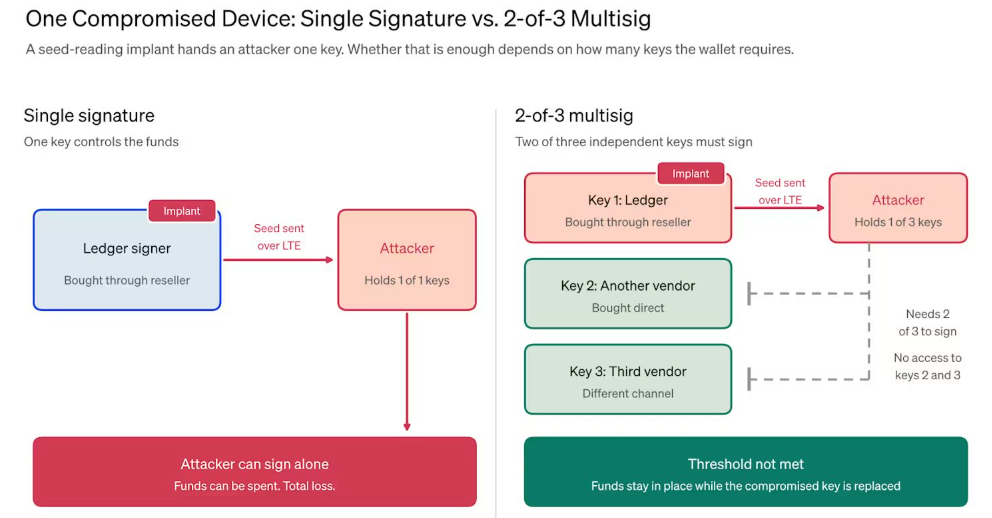
Even multiple permissions cannot prevent every attack.
Safe Labs’ Rumalla said that multiple signers could still allow malicious transactions if they were all spoofed by the same compromised interface.
Related: Can crypto users trust the supply chain behind hardware wallets?
Seedless wallets remove one risk, introduce another.
Tangum says its badgeless design makes self-custody easier by eliminating the need to administer a recovery sentence. Instead, consumers must protect the physical devices that provide access to their funds.
A private key is generated on a card, with backup copies stored on up to two additional devices. Tangem confirmed to Cointelegraph that losing each device will permanently lock users out of their funds.
The company said it had not received any reports of customers losing all their cards.
Securing cards also does not protect consumers from authorizing malicious transactions. Zack Herbert, CEO of rival hardware wallet maker Foundation, said badgeless backups can protect themselves, but criticized Tangem’s lack of a built-in screen, which leaves users relying on their smartphones to verify transaction details.
“An attacker doesn’t need to extract your private key if he can trick you into authorizing a transaction that will empty your wallet,” he said.
Magazine: 5 Ledger Alternatives to Store Your Bitcoin