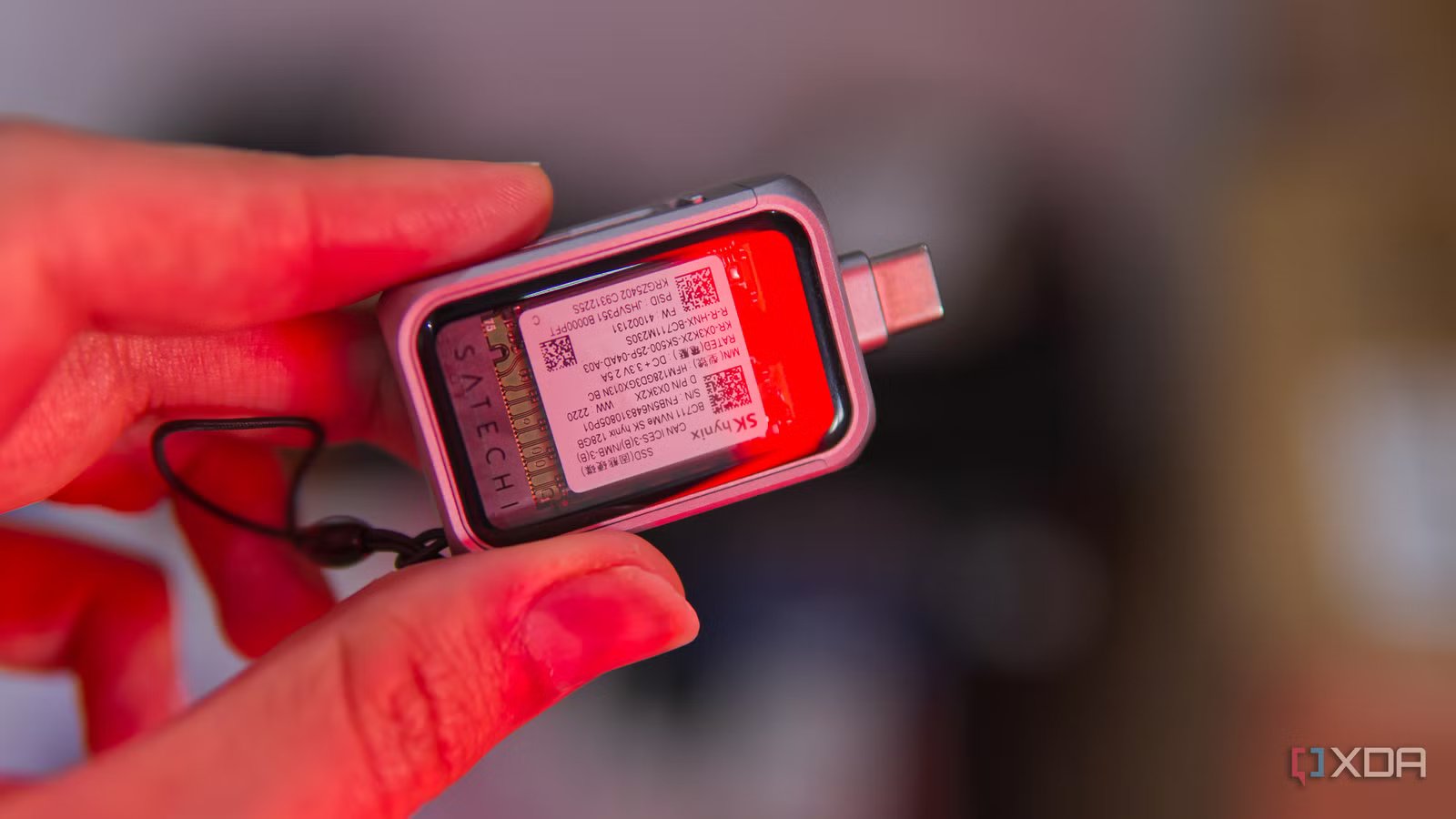
My computer’s two M.2 slots were already occupied, and my home media server was taking up a significant portion of the storage space. Since I already had fast USB-C ports, I thought I’d give my system the storage space it needed With external SSD.
The external SSD I chose was more than capable of handling my home media server needs. However, it wasn’t offering anywhere near the transfer speeds it was rated for. After investigating the usual suspects, I realized that the problem was not with the drive itself, but with the USB hub that connected it to my computer.
Connecting the SSD directly to my computer revealed the suspect
My USB hub was holding the external SSD drive

While my first instinct was to blame the external SSD, I didn’t do so immediately. After all, I had a USB hub between my computer and most of the other accessories connected to it. So, I connected the drive directly to my computer, and it worked as it should.
A quick test on CrystalDiskMark showed that the external SSD reaches the advertised sequential read and write speeds. I also did a hands-on test by transferring large files and reading them from there, and as expected, I didn’t see any noticeable issues.
These tests were enough to rule out the SSD as the primary culprit, and also ruled out the drive cable, which could have been the problem. This made me realize that USB hubs are not just passing accessories.
USB hubs can slow down external SSD drives
Not all USB hubs offer the same transfer speeds

All USB hubs have their own hardware limitations, and these limitations greatly affect the connected devices. In my case with the external SSD, support for the high-speed USB 3.2 Gen 2×2 standard did not help due to the presence of a USB 3.2 Gen 1 hub Between him and the computer.
The hub itself was connected to a USB4 port, which meant the PC port still had plenty of headroom. Of course, it’s not as if there aren’t fast hubs available. It’s just that the axle I was counting on wasn’t cutting it.
Multiple devices were competing for the hub’s bandwidth
The SSD wasn’t the only device plugged into the hub
Further digging into the specs and bandwidth made me realize that even if I got a hub that matched the speed of the external SSD, I would lose some performance. After all, it wasn’t just the storage engine that was competing for the core’s bandwidth.
My hub also handles USB dongles for my wireless keyboard, wireless mouse, controller, and sometimes my phone. So, for To get the speed that my SSD can achieve, I’ll need a fast USB4 hub Downstream ports.
A USB hub that is underpowered can also cause problems
External SSD drives need enough power to operate reliably

The thing is, USB hubs don’t just handle data transfer bandwidth. They also provide connected devices with the power they need to function, and this can become another limitation.
An external SSD drive may work perfectly fine when connected directly to your computer, but slow down when connected to a dock or hub, even when there is enough bandwidth. in In these cases, the hub may not provide enough power, and the drive may be compromised Data errors due to unexpected disconnections.
This is another reason why you shouldn’t choose a USB hub solely based on data transfer speeds. You should also consider power delivery capabilities and check if the devices you plan to connect to will get enough power from them.
Don’t ignore the USB hub when using high-speed peripherals
The accessories may not be the problem

These days, storage is expensive, and the last thing I want is to replace a perfectly capable external SSD because it didn’t meet my expectations. SoI was happy that the drive wasn’t the issue, and I could keep the SSD connected to the PC’s fast USB4 portAll the time.
However, I prefer to keep my external SSD unplugged when not in use. So, the solution to my case was to simply replace the USB hub, which didn’t cost as much as replacing the 2TB external drive.