Even if you bought the most expensive PC possible, you’d be lying if you said you weren’t trying to squeeze every frame out of it. The best components don’t work the way they should unless you also spend a few hours tweaking their settings, and that’s before you even get to overclocking.
I’ve spent enough time modding computers to know that the default configuration they come with isn’t the best or most optimized for gaming. This is understandable too, since motherboards should be shipped with stability and compatibility prioritized rather than performance.
While I won’t touch overclocking with a barge pole since new parts today cost a fortune, there are a lot of settings in my motherboard’s BIOS that I’ve tweaked that have really improved the performance of my gaming PC with realistic, workable returns.
Enable XMP or EXPO to get faster memory
Your expensive RAM is not performing at the advertised speed by default
Every time I mention XMP or EXPO, it seems redundant, because it’s easy to assume that everyone who builds a gaming PC knows about it. However, the reality is that power users only make up a small percentage of PC gamers, and the general user still buys (or sells) the best parts they can without knowing how to maximize their performance themselves. XMP/EXPO is probably the most important feature that the average user neglects, allowing their RAM to remain at slower speeds.
Buying a 6000MT/s DDR5 kit does not mean that your motherboard will actually run at 6000MT/s. By default, most motherboards leave performance on the table in favor of a secure first boot. Fortunately, fixing this takes seconds.
Intel’s Extreme Memory Profile (XMP) and AMD’s Extended Overclocking Profiles (EXPO) are pre-configured memory profiles that allow you to actually run your RAM at the advertised speed, timing, and voltage printed on the box. The exact name and location vary between motherboard manufacturers, but are usually easy to find.
Technically, enabling XMP or EXPO is overclocking the memory, even when you are simply activating the advertised specifications of the set. However, it’s the most reliable and stable form of RAM overclocking that the manufacturer actually expects you to do, so running it is always a safe bet.
Set custom fan curves for quieter gaming
The motherboard does not know how much noise it is willing to tolerate

Motherboard manufacturers have no idea whether you’d rather have a super-quiet gaming PC, or a tower that mimics a jet taking off. The motherboard’s default fan curves are fairly generic, and increase aggressively as temperatures rise. Either that, or they’re allowing the components to run hotter than necessary.
The only way to fix this is to control your fans and their curves. Head into your BIOS and look for the Device monitoring or Fan control to divide. This is where you can adjust the fan curves for your CPU cooler as well as your case fans. Setting a more moderate curve at low temperatures will keep daily workloads quiet, but you can also use a steeper slope under sustained loads to ensure the cooler gets enough airflow to your CPU while gaming. This helps prevent the CPU from reaching maximum thermal throttling, and for those using Ryzen CPUs, it’s a particularly useful step for adjusting and fine-tuning the fan curves.
Don’t simply set everything to the minimum speed and stop every day. Your CPU and GPU need enough airflow to maintain boost clocks without thermal throttling. This part takes some effort and focus, but it’s worth the effort to monitor and use your temperature readings from actual gaming sessions to fine-tune your curves.
Enable enhanced accuracy for overdrive
Let your Ryzen CPU push its limits automatically

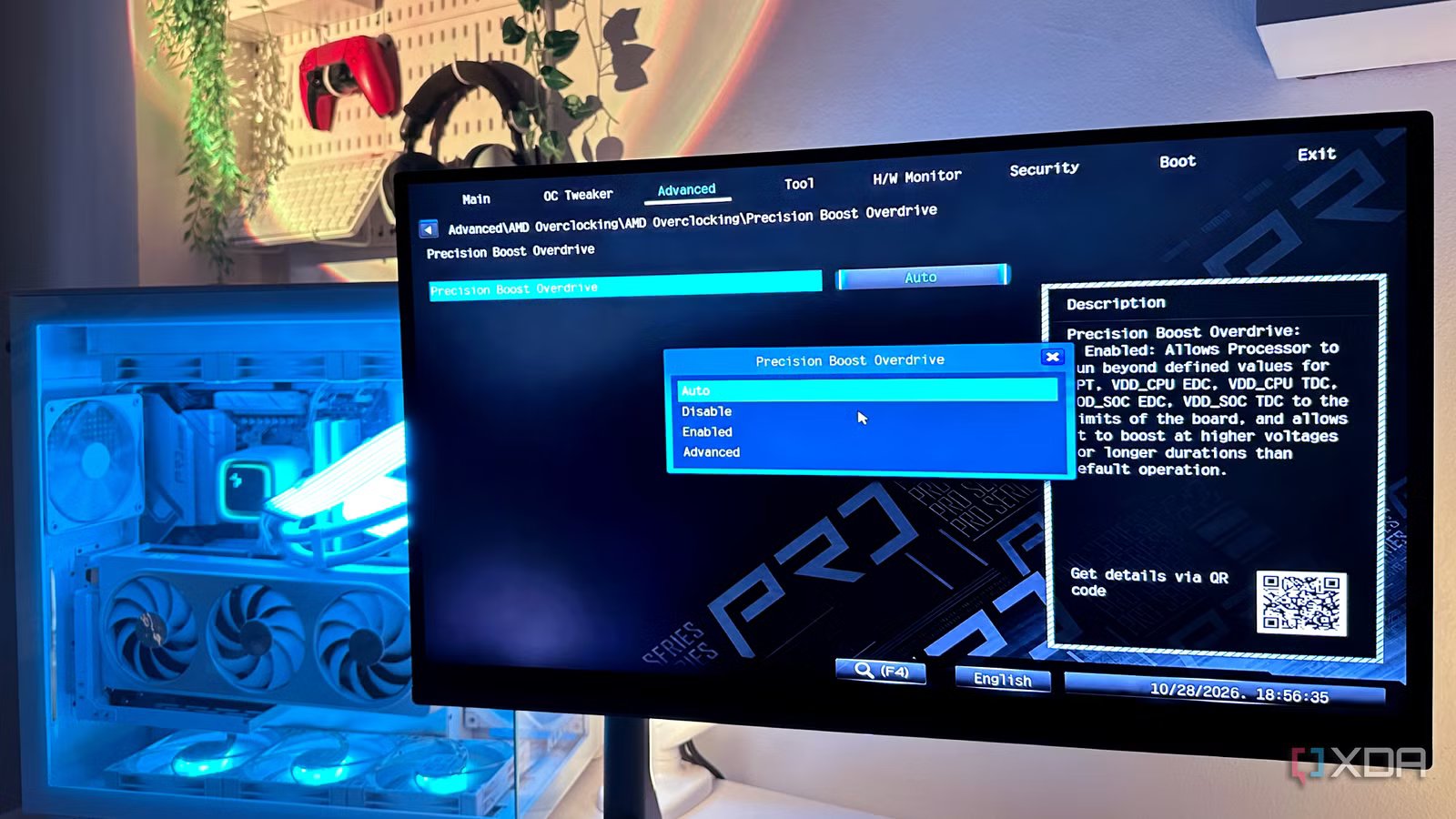
AMD’s Ryzen processors are great at extracting performance from their silicon, but their default power and boost limits can leave some headroom unused. If your Ryzen CPU supports it (AMD Ryzen 5000, 7000, and 9000 series desktop processors and Threadripper chips), Precision Boost Overdrive (PBO) can allow the chip to be pushed beyond stock limits, as long as temperature, power delivery, and cooling allow it.
You don’t have to worry about every clock speed on the CPU, so it’s not as sensitive as manual overclocking, but it still allows the processor to stretch its legs.
You’ll find PBO in your BIOS, usually under AMD Overclocking or a submenu with a similar name. Set it to Enabled or Advanced, depending on your motherboard, and let the processor manage the boost behavior automatically. Don’t expect a dramatic increase in frames per second (FPS) in each game, since the actual gains vary from CPU to CPU, depending on your performance in the silicon lottery.
Intel processors don’t have a direct equivalent to AMD Ryzen’s PBO, but they do have Turbo Boost technologies, which automatically raise CPU clock speeds based on workload, temperature, and power spikes. However, it operates strictly within Intel’s default built-in power caps out of the box.
Enabling Resizable BAR improved the performance of my GPU
Stop making your CPU request GPU memory in small chunks
Your graphics card may have gigabytes of VRAM, but that doesn’t automatically mean your CPU can access it all at once. Traditionally, systems expose a relatively small portion of the GPU’s memory through the PCIe interface, which Possibly It creates unnecessary overhead when games need to transfer large amounts of data. Resizable BAR changes this by allowing the CPU to access the entire GPU frame buffer when supported.
Enabling it usually involves turning it on A resizable bar (without thinking) In the motherboard’s BIOS. You will also need a compatible processor, motherboard, graphics card, and BIOS configuration. The only thing you should make sure in your BIOS settings is that Resizable BAR is actually set to “On”, not “Default” or “Automatic”.
AMD’s equivalent is called Smart Access Memory (SAM), which uses a resizable strip to allow compatible Ryzen processors to access the GPU’s VRAM buffer. You’ll need compatible AMD hardware and BIOS support, of course, but the core technology remains the same.
Performance gains are highly game dependent, with some games benefiting more than others. However, many users have also reported ReBAR affecting their performance, which is why GPU vendors maintain game-specific profiles. The best way forward here is to test your usual games rather than just assume that ReBAR is a one-size-fits-all performance improvement.
AM5 run times were cut in half using memory context retrieval
It became non-negotiable for my computer
If you’ve ever wondered why your AM5 gaming PC takes forever to boot despite a fast SSD, training on DDR5 memory may be the reason. After enabling EXPO, your motherboard has to create stable memory parameters, and repeating this process at every startup can add an unreasonable amount of time to your morning routine.
Enabling Memory Context Recovery (MCR) in your BIOS can fix this Reuses previously defined training data Instead of starting from scratch. Depending on your motherboard, you’ll find the MCR under the BIOS’s DRAM settings or the AMD CBS submenu. On systems that spend 45 to 50 seconds training memory, enabling it can reduce boot time to approximately 10 to 20 seconds. Your results will vary, but saving half a minute from each startup without purchasing anything is a pretty compelling upgrade.
Unfortunately, MCR is also known to cause memory instability and POST failure in some AM5 computers. This problem has largely settled as AM5 now has plenty of time to mature. Pairing it with Power Down Enable can help maintain stability, although results depend on your hardware and BIOS.
Make sure you test things thoroughly, but also be prepared to disable the MCR or clear your CMOS if your computer refuses to cooperate.
You can always upgrade your computer without purchasing new hardware
It can be very satisfying to get more out of your computer without spending an extra dime, especially when you’ve already spent a small fortune building it in the first place. All it often takes is what your motherboard has been doing behind your back.
Of course, tweaking the BIOS isn’t about blindly enabling every seemingly performance-oriented setting. Every system is different, and what works beautifully in one configuration may cause problems in another. The best thing you can do is make one change at a time, test your results, and keep track of what you’ve modified.