Somewhere between the Binance hack and the US midterms, Paul Sztorc’s long-awaited Bitcoin fork, known as the eCash network, went live.
On October 29th, Sztorc, the founder of LayerTwo Labs and the driving force behind the Bitcoin Drivechain proposals, was introduced BIP300 And BIP301 has launched a separate Bitcoin fork that aims to bring payments, privacy and other applications to a network built from Bitcoin code.
“We need to actively sabotage the ‘degrowth’ policies that are killing Bitcoin,” Sztorc tells Magazine.
“We want to find the true Bitcoin developers and give them the tools to actually innovate. We just need the open-minded, risk-taking adversaries to come and build.”
The hard fork gives eligible Bitcoin holders an interesting windfall: their corresponding BTC balance in the new chain’s native token, ECX.
What benefits does eCash bring to developers and what can Bitcoin HODLers actually do with their new coins?
What is eCash?
Developed by Sztorc’s LayerTwo Labs, eCash is a separate hard fork of Bitcoin that was born out of Sztorc’s frustration with some of the “complacency narratives” and “cult-like toxicity” that he believes have held Bitcoin back.

Sztorc rejects criticism of the security of drivechains. Source: archive.ecash
Its main innovation is Drivechains, a system that gives developers the freedom to create independent sidechains with different functions without having to make changes to Bitcoin’s base layer protocol (or in this case, eCash’s base layer).
Developers can experiment With various applications for payments, privacy, digital assets, and prediction markets, miners can “maximize their revenue” by earning additional transaction fees.
Five sidechains have been launched alongside the eCash mainnet: BitNames, BitAssets, Thunder, Truthcoin and zSide. Two more, the quantum-resistant Photon and the decentralized exchange CoinShift, will follow.
Related: Blockchain developer Paul Sztorc announces the BTC hard fork eCash
Stork belly issued has been championing Drivechains for over a decade and believes Bitcoin’s notoriously conservative development approach has stunted its potential.
“Anything that doesn’t maximize network usage is just a distraction,” he says. “Users who actually pay transaction fees to miners will win in the long run.”
Get access to the new coins
The eCash fork has taken place at Bitcoin block 973,728, and anyone who controlled their private keys at the snapshot received a corresponding ECX credit.
“If you held the keys to your BTC in this exact block, you now own the exact same amount of ECX,” LayerTwo Labs tells Magazine. “It’s that simple and you can access it straight away.”
Like beauty, simplicity is in the eye of the beholder, and Bitcoiners who self-custody their coins must use a wallet that supports eCash and carefully follow the process of separating the ECX from their BTC.
Since the two networks share transaction history, an unprotected transaction on one chain could be repeated on the other chain.
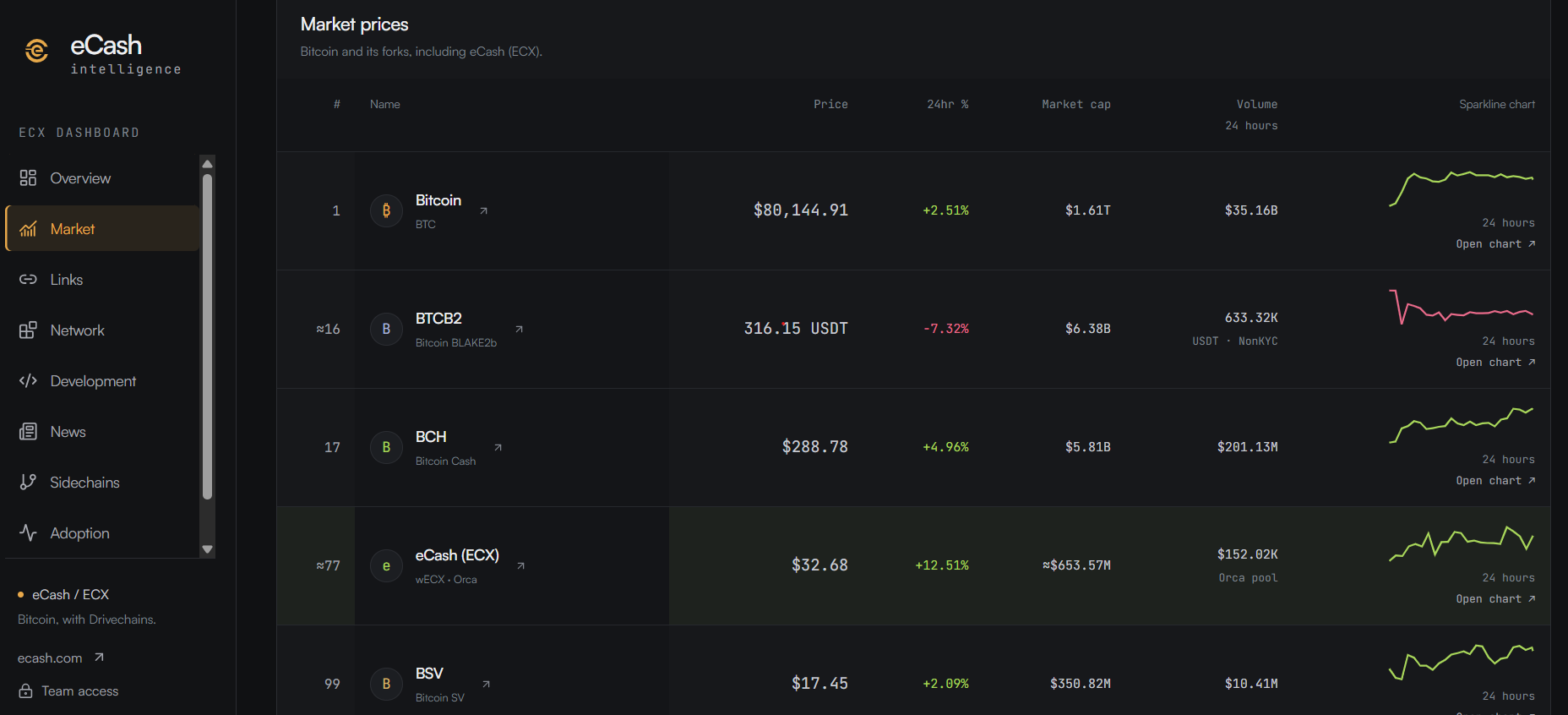
eCash market prices. Source: eCash.
“Never move your BTC first, as normal, unprotected BTC output can easily be reflected on the ECX network,” warns LayerTwo Labs. It says replay controls are built into the protocol, but the company advises holders to transfer ECX first before spending BTC.
Anyone holding BTC on a centralized exchange is “at their mercy” when it comes to distribution and should check whether their exchange supports the fork or has announced an ECX distribution.
Where can holders trade ECX?
Accessing ECX is not the same as being able to sell it, and the tokens are not yet widely available on major crypto exchanges. Depending on which country you are in, Bitcoin forks may have tax implications that are worth finding out about before filing your next tax return.
NeoxEX said It opened native ECX deposits, withdrawals and trading on ECX/USDT, ECX/USDC and ECX/BTC pairs on October 29, while CoinW announced plans to distribute ECX to eligible Bitcoin holders, with deposits, withdrawals and trading to be announced at a later date.
Orca, a decentralized exchange on Solana, allows users to exchange USDC for Wrapped ECX (wECX) via a liquidity pool. This gives holders another way to trade ECX, but requires a wrapped token on a different blockchain rather than native ECX trading on the eCash network.
Related: Binance and Polymarket are seeking a hard fork of Polygon to recover $6.8 million worth of stolen cryptocurrencies
How much are the tokens worth? CoinMarketCap placed ECX at $32.63, with a 24-hour trading volume of around $355,000 (as of November 5), while CoinGecko shows the token as a preview listing, with no price yet available and no exchange markets tracked. Crypto market data provider Kaiko says it does not track ECX, limiting the availability of independent market data.
According to LayerTwo Labs, ECX fluctuated between $40 and $50 at the start of trading, but did not provide supporting figures on order book depth or trading volume, instead pointing to the total locked value of the Orca pool to give users the opportunity to assess the available liquidity.
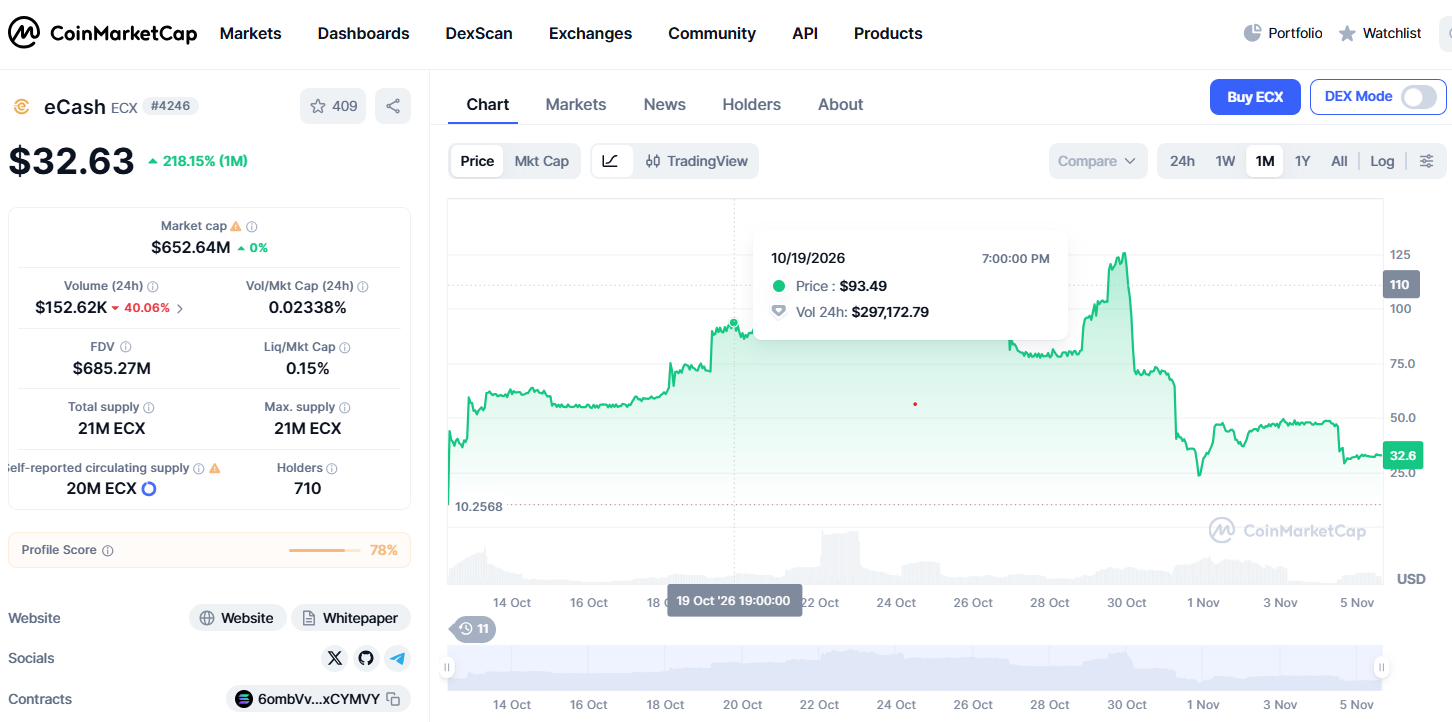
eCash was trading at $32.63 on CoinMarketCap on November 5th
“If our fork replicates even a fraction of the initial performance of (Bitcoin Cash) BCH,” says Sztorc, “the liquidity will be breathtaking,” adding that anyone worried about low liquidity can hold on to their coins and decide later.
“We are actively adding new exchanges and trading pairs, so the user experience will only improve,” he says. “Otherwise, feel free to take your free money and leave.”
A different vision for Bitcoin
Sztorc says the value of eCash will ultimately depend on whether developers create useful applications and users are willing to pay for them. Paying customers and revenue from transaction fees are the project’s key measures of success in the first year, he says.
He’s not worried criticism the security model of drivechains, particularly the “superstition” that miners can coordinate to steal funds stored on sidechains.
“If you really believe that miners are setting fire to their own multi-billion dollar operations for a short-term theft on an L2, then you shouldn’t trust Bitcoin’s L1 either,” he says.
So for now, eCash offers Bitcoiners a new asset and developers a new playground – but whether ECX becomes much more than that depends on whether anyone actually wants to use it.
Magazine: Bitcoin turns 18: has the original rebel grown up?