If rising geopolitical tensions weren’t a cause for concern, now it’s crypto’s turn to go nuclear
The industry is busy debating a cryptographic doomsday scenario in which attackers derive private keys from public keys using a far-fetched, but now potentially credible, AI scenario that puts everyone’s crypto at risk.
Ethereum researcher Justin Drake Called last Wednesday to plan “Bunker Mode,” citing “modest” advances in artificial intelligence that could accelerate the discovery of mathematical attacks and eventually “break” cryptography:
“IMO it is now reasonable to think about the possibility that ECDSA (Elliptic Curve Digital Signature Algorithm) will be broken before Qday, not months at worst but years.”
Drake believes the industry should begin planning to transfer control of assets to new addresses whose public keys have not been exposed, reducing the amount of information a potential attacker could exploit.
But on what basis is he making this warning, and is there any real cause for alarm?
Is Crypto Panic Justified?
Drake’s concern is not just whether AI will accelerate the advent of quantum computers capable of breaking encryption, but whether AI systems can also help discover mathematical attacks using classical computing that human cryptographers have missed.
He argues that elliptic curves – the cryptography that underpins most blockchains – may be more vulnerable to such developments than hash functions due to their more mathematical structure, increasing the likelihood of classical algorithms breaking elliptic curve cryptography.
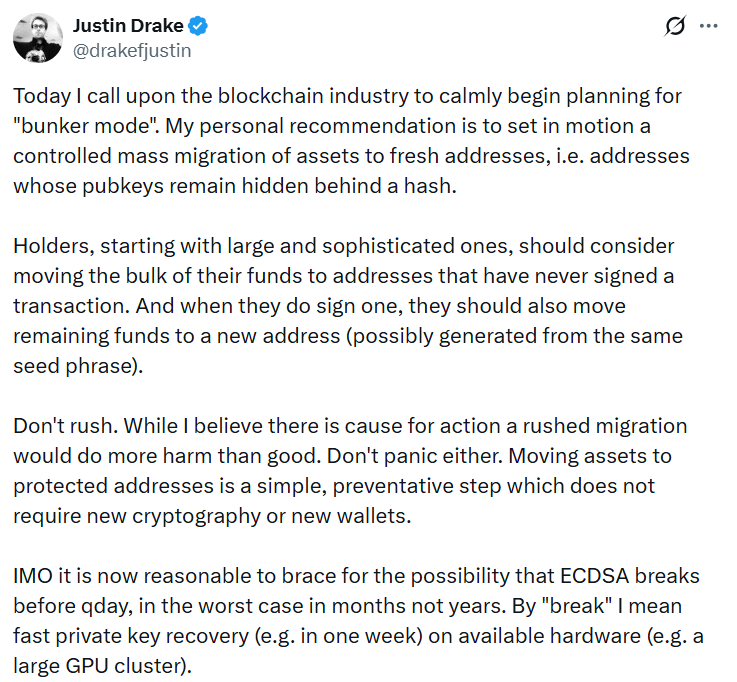
Justin Drake wants the industry to plan for bunker mode. Source: Justin Drake
Matthew Green, professor of cryptography at Johns Hopkins University, I weighOn Drake’s assessment, adding fuel to the flames of panic already spreading in the crypto industry.
“I think we can lose public key cryptography,” he said.
Related: The holdup is too big: Can AI slow down and crash the economy?
Not everyone shares their alarm. Yehuda Lindell, Coinbase’s head of cryptography, said that, to his knowledge, there is “no evidence” that the decades-old mathematical hypothesis underlying the elliptic curve has been undermined;
Lucian Borden, bitcoin analyst at hardware wallet Treasure, tells the magazine:
“There are no credible published developments with AI or anything else against the mathematics behind ECDSA.”
He says that none of OpenAI’s recent releases of AI-authored math papers have attacked ECDSA — though Drake thinks that’s cause for skepticism rather than comfort. Drake’s second argument is that elliptic curves have more mathematical structure than hash functions, which can make them easier to break.
“He doesn’t say how,” Borden says. “He also calls his timeline a worst-case scenario and tells people not to rush.”
Zack Herbert, chief executive and cofounder of Hardware Wallet Foundation HQ, told the magazine that transferring funds to new addresses would not be sufficient if an extended public key (xpub) was already shared with a wallet app or third party.
In that case, “they already have the information they need to get the public keys you’re trying to hide,” he says.
And as Taylor Monahan, founder and chief executive of Ethereum wallet Metamask, pointed outif the encryption is broken, the value of your bag won’t be your only concern:
“If the elliptic curve is broken so that any exposed public key leads to compromise and it’s by a financially motivated hacker whose first priority is to steal crypto, the entire world will be zero. Keeping your magical internet coins in bunker mode won’t help you.”
Why can’t walking be enough?
X-Pub allows wallets to create multiple public keys for a single account, including addresses that have never been used, says Herbert.
If a wallet app or third party already has that information, transferring funds to a new address within the same account cannot hide the new address’s public key from them.
If ECDSA became practically breakable, “an attacker could recover the corresponding private keys without ever touching your hardware wallet.”
Related: Dragonfly Partner Rejects ‘Bunker Mode’ Domism, Calls for Proactive Blockchain Initiatives
“No, it’s clearly not enough protection,” Eli Ben Sasson, co-founder and chief executive of Ethereum scaling protocol Starkware, told the magazine.
“Besides just transferring your coins, if you want to use them again, you’ll need to download a new type of wallet.”
They say the break will have more impact than wallet signatures. Ethereum’s infrastructure-level signatures and consensus mechanisms will also need to be addressed, such as the Kate-Zaverucha-Goldberg (KZG) polynomial commitment scheme used for data in blobs.
“Finally, gas prices are also likely to rise dramatically, as a lot of functionality will be broken,” he adds.
On Bitcoin, some types of addresses hide The full public key behind a cryptographic hash until the coins are spent. If the corresponding hash functions are preserved, this can provide an additional layer of protection against an attacker trying to derive the private key from the public key. A taproot address, in contrast, Exposed A public key directly on-chain.
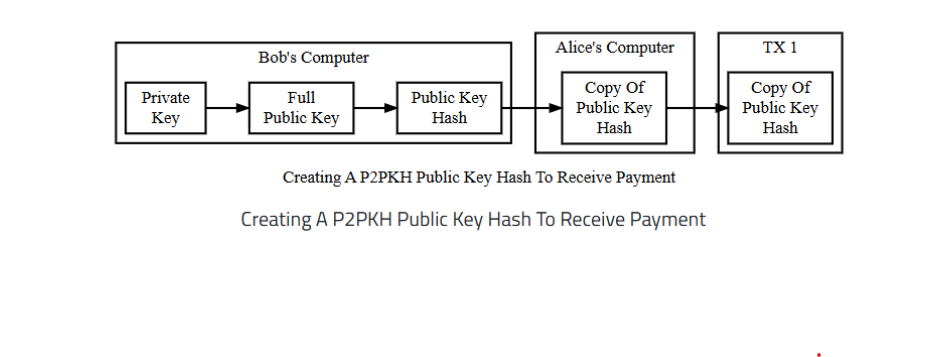
Creating a P2PKH public key hash to receive payment. Source: Bitcoin.org
Common SegWit addresses, starting with bc1q, keep public keys private until they are spent, Bourdon says, and wallets like Trezor generate new recipient addresses to limit address reuse.
“There is nothing to do now,” he says, adding that a panicked migration would do more harm than good. “People rushing to transfer funds make mistakes, and scammers use stories like this to get to them.”
It’s also worth noting that whenever you spend Bitcoin, the public key is exposed in the memory pool anyway, which opens up an opportunity for attack.
Not all crypto assets are created equal
Some blockchains are already preparing for cryptographic threats, although their proposed solutions vary.
On the AI-focused NEAR protocol, users can add A quantum-safe FIPS-204 key of an existing mainnet account in a single transaction, without transferring their assets, and wallets like Meteor support quantum-safe signing. It relies on lattice-based cryptography, which Ethereum creator Vitalik Buterin fears could also be vulnerable to attack.
There is Ethereum. developing A broader post-quantum roadmap uses hash-based signatures and ZK-proof aggregation, covering everything from transaction signatures to consensus and data security. It also papered over an emergency hard fork and recovery proposal.
In a March 2024 post, Vitalik Buterin sketch A potential hard fork that would roll back blocks once a mass theft occurs would disable traditional wallet transactions and allow users to reclaim funds using zero-knowledge proofs of the seed phrase.
Related: Vitalik Buterin Supports Crypto ‘Bunker Mode’ Amid Rapid AI Math Development
Max Shannon, senior research associate at BitWise Europe, says a proposal remains with “no fixed timeline”.
While no one has yet demonstrated a working attack, he says users should switch to quantum-safe signatures “over the long term.”
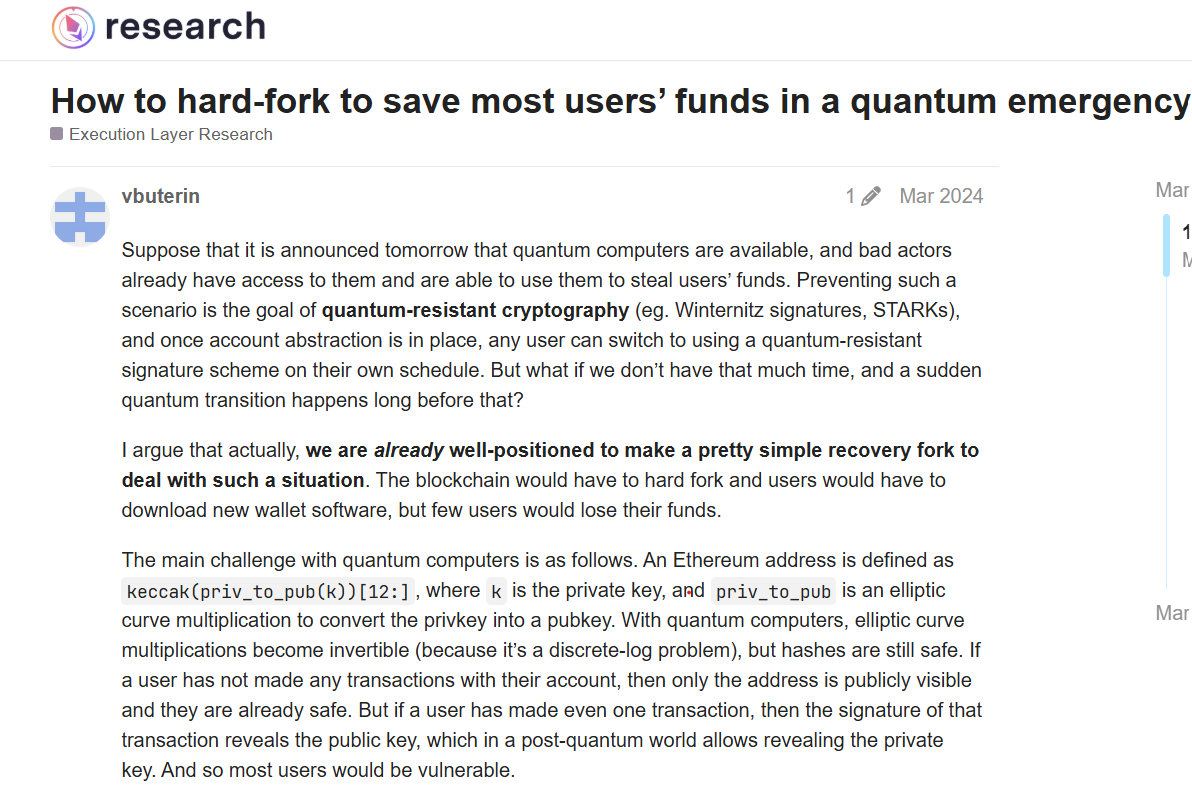
A hard fork in a quantum emergency. Source: Eth Research
Starknet’s account abstraction architecture allows users to switch signature schemes without transferring funds to a new address. Ben Sasson says the underlying technology doesn’t need to change, “because account abstraction means you can take any signature scheme.”
But he says other components still need attention, including the state tree portion of the network and its reliance on Ethereum for security.
Switching to a new address won’t help users on Solana, as public keys are exposed by default — although they can transfer funds to a post-quantum wallet like a winter wallet.
Solana Foundation Vice President of Technology Jacob Creech said Solana users won’t need to enter “bunker mode” if its signature scheme becomes crackable.
A network upgrade could allow users to prove ownership of their secret token using hash-based proof and move their accounts to a secure signature scheme. Practical proof of concept existsThey say, though the upgrade itself has not been deployed.
So, should crypto holders panic?
Shannon says Bitwise isn’t worried about this theoretical risk right now, but it’s “worth being cautious about.”
“We can discuss the new address and exposure to xpub as a thought experiment,” says Herbert, “but I wouldn’t consider those steps to amount to a practical plan for this scenario.”
Because some people have older devices, complex multi-signature arrangements, or bitcoins that haven’t been touched in years, he says a software update “will not automatically protect those coins.”
Borden reminds crypto holders to check the source, as Ethereum’s move toward hash-based cryptography was accompanied by Drake’s warning.
“So a warning about an unproven threat doubles as a pitch for Ethereum’s roadmap,” he says.
While this does not disprove Drake, there is still no evidence that ECDSA is about to collapse, and there are considerable risks involved in rushing to transfer funds.
But if the cryptography underpinning crypto-wallets and blockchains fails, moving the coin may be the easiest part of the industry’s response.
Magazine: Crypto Lending Rises Again… But Have They Addressed The Risks?
Cointelegraph publishes long-form journalism, analysis and narrative reporting produced by Cointelegraph’s in-house editorial team with subject matter expertise. All articles are edited and reviewed by Cointelegraph editors according to our editorial standards. Some articles contain affiliate links, from which Cointelegraph may earn a commission. These relationships do not influence which products we review or our editorial results. The material published here does not constitute financial, legal or investment advice. Readers should do their own research and consult with qualified professionals where appropriate. Cointelegraph maintains complete editorial independence.