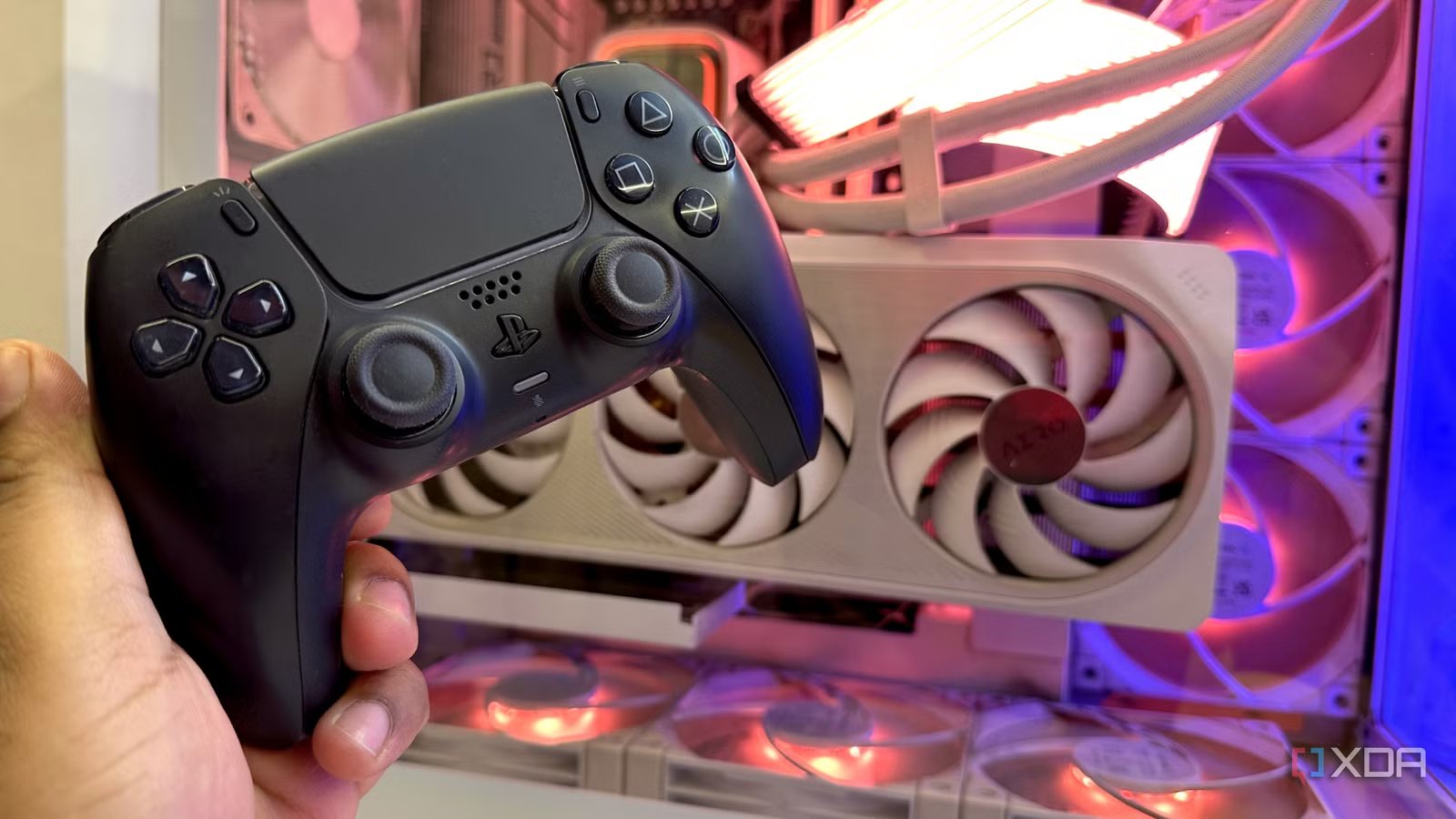
The DualSense is one of my favorite controllers to use on PC, but Sony has always made me work for that privilege. There’s nothing quite like a console when you’re playing on PlayStation 5, thanks to great haptics, adaptive triggers, a built-in speaker, and everything else that makes the console feel really different.
However, on PC, these features aren’t wireless, and if you connect your DualSense controller to Windows via Bluetooth, a lot of the magic is gone. For years, I simply accepted this as the price of using Sony’s controller wirelessly on my Windows PC.
After years of keeping the controller permanently wired, I found something that made my DualSense unleash its full feature set even while connected wirelessly to Windows. Now, the Sony controller is, once again, the controller I use when it’s time to play games.
Wireless connectivity is where the DualSense magic goes to die
My PS5 controller features a cable-shaped character on the PC

The DualSense has a somewhat awkward split personality on a Windows PC. When connected via USB, Windows gives compatible gamers access to high-resolution touch devices, adaptive triggers, a speaker, microphone, and even a 3.5mm jack. However, when I want to reduce the clutter on my desk and connect it wirelessly, I’m mostly left with very An expensive version of the basic gamepad. The buttons work perfectly, but much of what makes the DualSense special requires a cable to your PC.
This is primarily because the DualSense’s advanced haptics are delivered through an audio stream, and the standard Bluetooth implementation for Windows doesn’t display that stream for PC gaming. Adaptive triggers are much less restrictive, but touch is where things get really frustrating, given the persistence of native wireless support To the fullest extent rare.
I could have simply accepted that, but I wanted my DualSense to actually act like a DualSense without being tethered to my computer. This led me to the DS5Dongle, an innovative little project that uses a Raspberry Pi Pico 2 W to receive the controller wirelessly and present it to Windows as a wired controller.
For a moment, I was ready to buy a Pico 2 W and build my own DualSense device. It was ridiculous that I needed a microcontroller to solve a problem that Sony and Windows were supposed to address years ago. Fortunately, before I gave up and ordered one, I found a way to remove the Raspberry Pi from the equation entirely.
The ZerkSense5 removes the Raspberry Pi from the equation
My DualSense finally forgot it was connected via Bluetooth
This is the place ZerkSense5 enters the picture. Instead of placing the Pico 2 W between the console and PC, it does the same trick entirely in software. I paired my DualSense normally via Bluetooth, turned on the ZerkSense5, and watched it create a virtual wired controller using usbip-win2. Windows loaded the usual drivers, while games were presented with what looked like a cabled DualSense.
Installation was relatively easy, with the app itself walking me through the process and installing the required helpers. The virtual console side of things is completely handled by ZerkSense5.
However, the real test was whether this software illusion actually worked. I launched the same games that would normally force me to connect the DualSense via cable and tried them over Bluetooth with the ZerkSense turned on. Adaptive triggers are initiatedAnd the high-resolution touches worked, too. My controller was sitting wirelessly on my desk while the game acted as if I connected it directly to the computer.

In fact, to my surprise, the ZerkSense5 also offers a tremendous amount of control over the controller’s behavior, from trigger sensitivity to touch intensity, allowing me to double the amount of rumble for certain games if I wanted. However, the party trick that stole the show was the tool’s ability to record the DualSense’s playback behavior for any game and then transfer it to another game without any trigger feedback. I took the DualSense’s operating behavior from The Witcher 3 RemasteredI put it in it Al-Din ringwhich really improved my experience playing the latter game (i.e. the superior RPG).
Plus, credit where credit is due — ZerkSense5 DS5Dongle Credits For the basic idea, even while porting the entire workaround from the Pico 2 W to the PC itself. The entire Raspberry Pi project I thought I’d have to get involved with is now just one download from the GitHub repository.
You won’t need a Raspberry Pi anymore
I can still see the benefit of sticking with the dongle

After years of the DualSense offering a risky wireless experience on Windows, it’s strange how we suddenly have so many ways around Sony’s limitations. In fact, there’s also the DualSenseX, which offers the same wireless functionality as the ZerkSense5, but it’s a paid app. Meanwhile, more and more games are finally offering full support for the DualSense, e.g No sky man.
The best and easy way to enjoy the PS5 controller on PC remains, without a doubt, the ZerkSense5. It’s free and open source and doesn’t require a Pico 2W, soldering, extra cables, or any other small box that sits between the console and the computer. Once you install it, simply add it to your Task Scheduler and run it every time you turn on your PC, and you’ll never have to reach for a USB cable to connect your DualSense to Windows, again.
There is one reason why I keep choosing DS5Dongle. If your DualSense regularly switches between multiple computers, the Pico 2 W has a real advantage. After all, the Pico 2 W is still around $10 (or less), and it’s a plug-and-play device that you can carry when you take the DualSense with you. In contrast, you will have to install and configure ZerkSense5 on each computer.
For everyone else, that’s a ridiculous amount of engineering to avoid a USB cable — and I mean that as a compliment. What once convinced me to consider purchasing a Raspberry Pi now requires little more than a download. Finally, the DualSense can remain wireless without leaving its best features behind.
I’m glad people have enough acceptance of the limitations
I’ve spent enough time with PC hardware to know that the most satisfactory repairs are rarely the most expensive. Sometimes, the problem is simply that everyone has accepted annoying limitations long enough that overcoming them seems like normal behavior.
The DualSense is a perfect example of this, and I’m glad someone decided that “just using a cable” wasn’t a good enough answer. If this is what a little open source ingenuity can do, I’m starting to wonder what other hardware limitations we’ve simply learned to live with.